How many days a week should you work out? The answer for your level and your week
Two, three or five days a week? What the research says, how many sessions fit your level and goal, and sample weeks you can start this Monday.
· 6 min read

The short answer: for most people, three days a week is the sweet spot. It’s enough to make steady progress, it leaves a rest day between sessions, and it fits around work and family. Beginners do well with two or three. Four or five days make sense once you have the time and you split the work between muscle groups.
The longer answer depends less on a magic number than on two things: how much work you do over the whole week, and whether you’ll still be doing it in three months.
How many days, by level and goal
| Your situation | Days a week | How to split it |
|---|---|---|
| Complete beginner, or coming back after a long break | 2–3 | Full body each session |
| Training regularly for a few months | 3–4 | Full body, or upper body / lower body |
| Experienced, chasing muscle or strength | 4–6 | Split by muscle group or movement |
| Just staying healthy | 2+ strength sessions, plus daily movement | Full body, plus walking, cycling or anything that gets you moving |
That last line comes from the World Health Organization’s guidelines: adults should do muscle-strengthening activities on at least two days a week, plus 150 to 300 minutes of moderate activity like brisk walking. Two short strength sessions and a daily walk already cover it.
What the research says
Each muscle about twice a week
A 2016 meta-analysis by Schoenfeld, Ogborn and Krieger compared training frequencies and found that working each muscle group at least twice a week built more muscle than working it once. That’s one reason full-body sessions work so well for beginners: three full-body sessions train every muscle three times.
Total work matters more than the number of sessions
A larger review in 2019 by the same team added a nuance: when the total amount of work over the week is the same, splitting it into two, three or more sessions makes little difference to muscle growth.
In practice, that’s good news. You can do 12 sets for your legs in two sessions or in four. Pick the number of days that fits your life, then make sure the week as a whole has enough work in it.
Rest days are part of training
Training doesn’t make you stronger during the session. It’s the stimulus, and you get stronger while you recover from it. That’s why most coaches recommend a day or two before you train the same muscles hard again.
That doesn’t mean you can’t train two days in a row. Legs on Monday and upper body on Tuesday is fine, because different muscles are doing the work. What you want to avoid is the same hard session every day.
Signs you’re doing too much:
- you’re still sore when the next session for those muscles comes around
- your numbers go down for a week or two instead of up
- you sleep badly or dread every session
Signs you could do more:
- sessions feel easy and nothing has changed in a month
- you finish with energy to spare and would like to train more often
The best number is the one you’ll keep
A plan for five days a week that you follow for three weeks gets you less than a plan for three days a week that you follow for six months. Before you pick a number, look honestly at your last month:
- Count the evenings or mornings you really had free, not the ones you wish you’d had.
- Pick fixed days, like Monday, Wednesday and Friday. “Three times a week, whenever” tends to become “once, on Sunday”.
- Pick a session length you can repeat. Three sessions of 30 minutes beat one heroic 90-minute session. Even 20 minutes is enough to train the whole body if the session is built for it.
- Decide what happens when you miss one. Move the rest of the week back by a day; don’t cram two sessions together.
Sample weeks
Two days: full body A and B
| Mon | Tue | Wed | Thu | Fri | Sat | Sun |
|---|---|---|---|---|---|---|
| Full body A | Rest | Rest | Full body B | Rest | Walk | Rest |
Three days: full body, the classic
| Mon | Tue | Wed | Thu | Fri | Sat | Sun |
|---|---|---|---|---|---|---|
| Full body A | Rest | Full body B | Rest | Full body A | Walk | Rest |
The next week, swap A and B so each session comes up as often.
Four days: upper and lower body
| Mon | Tue | Wed | Thu | Fri | Sat | Sun |
|---|---|---|---|---|---|---|
| Upper body | Lower body | Rest | Upper body | Lower body | Walk | Rest |
Five days or more works if you split by muscle group or movement (push, pull, legs, for example) and keep at least one full rest day. It’s a lot to keep up, so move there once three or four days have become routine.
How Yeonseup plans your week
Yeonseup starts from the days you can really train, not from an ideal week.
- Start with the fitness test. Plank, push-ups, squats and crunches at full effort give you a level from 1 to 5, and the app recommends programs for that level.
- Choose your days and time. When you start a program, you pick a start date, your training days and a reminder time. Your sessions appear in the calendar on those days.
- Or build it with AI. With Premium, tell the AI how many days a week you train (from 2 to 6) and how long each session lasts (from 20 to 60 minutes). It builds the program around that, and doesn’t train the same muscles hard in two sessions in a row.
- Miss a session? Late sessions show up in the calendar, and you can reschedule the rest of the program in one tap.
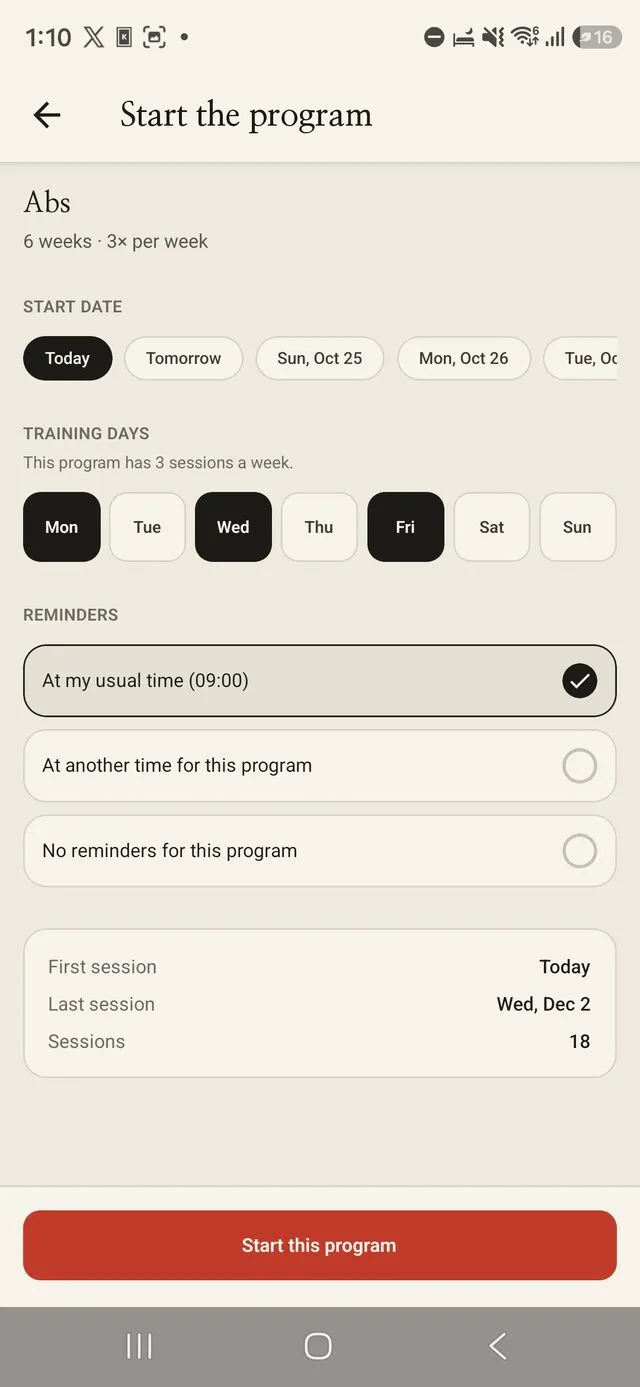
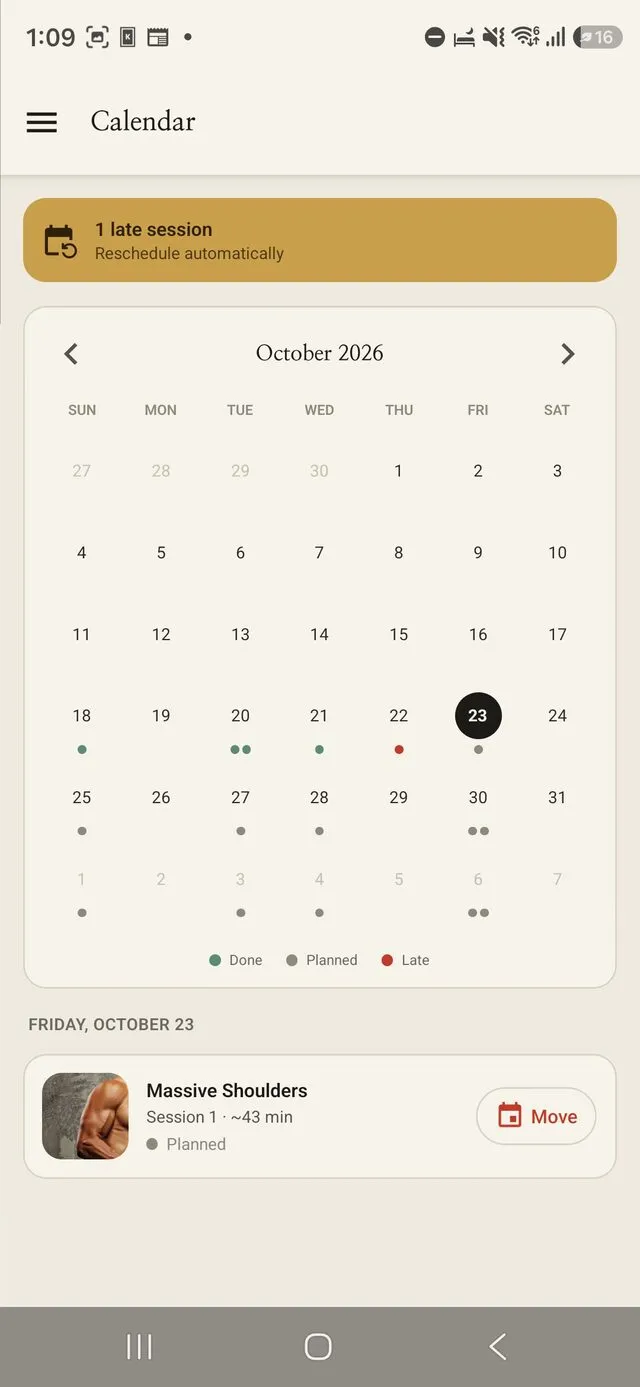
Program setup and the training calendar in Yeonseup.
Wondering how far AI planning can go? Read Can AI build your workout plan?
Frequently asked questions
Is it bad to work out every day?
Not if you vary it. Walking, mobility work or an easy bike ride every day is great. Hard strength training for the same muscles every day doesn’t leave them time to recover. If you want to move daily, alternate hard and easy days, or train different muscle groups on consecutive days.
Is two days a week enough to see results?
Yes, especially for beginners. Two full-body sessions train every muscle twice a week and meet the WHO minimum for strength training. You’ll progress more slowly than with three or four, but much faster than with zero.
Is it better to work out on consecutive days or spread them out?
Spread them out when you train the full body each time, with a rest day in between. Consecutive days are fine when the sessions work different muscles, like upper body one day and lower body the next.
How long should each session be?
Long enough to do the work, short enough to repeat. For most people, 30 to 45 minutes is plenty. 20 minutes works if the session has little rest and covers the whole body.